

180
Book · 2025
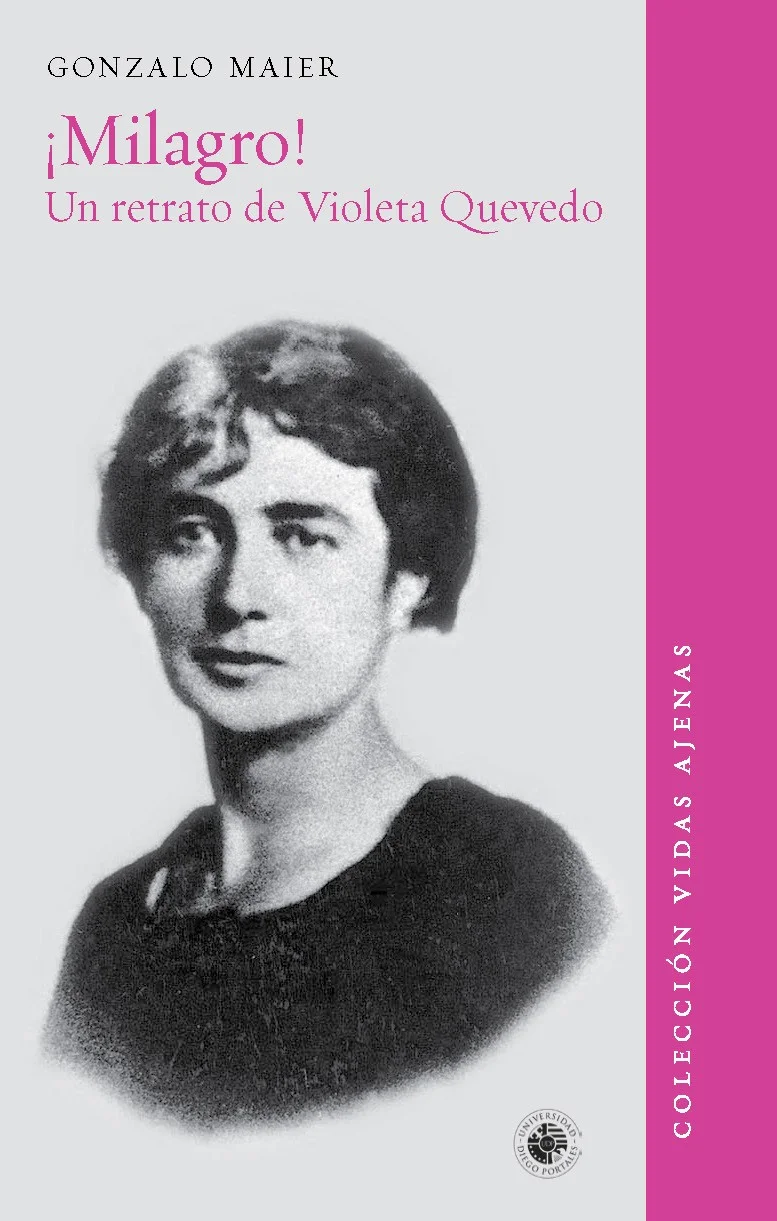
¡Milagro! Un retrato de Violeta Quevedo
In this biographical essay, Gonzalo Maier examines the eccentric life and singular literary voice of Chilean author Violeta Quevedo (Rita Salas Subercaseaux). Drawing on archival materials, forgotten chronicles, and period anecdotes, Maier traces how a devoutly Catholic, hypochondriacal aristocrat navigated Santiago's collision with modernity, while reflecting on the arbitrary nature of literary canons and the oddity of writing outside conventional forms.
Your call
Already know it? Recommend it too.
Details
Around the Web
The author, beyond the amusing anecdotes and the legend that surrounded Violeta Quevedo during her lifetime, rescues her writings above all for what they offer as a testimony to the social shifts that took place in Chile in the twentieth century, when wealth, prestige, and power moved from the countryside to industry, while old aristocratic fortunes were crumbling to pieces.
Héctor Soto on La Tercera I was very pleased with the appearance of this one in particular, because two "eccentrics" of our literature come together: Violeta Quevedo (her real name was Rita Salas Subercaseaux) and Gonzalo Maier, a storyteller with an enormous sense of humor, yet at the same time with tremendous respect for his biographical subject, a writer very difficult to approach given the legend of being extravagant, surreal, and aristocratic that precedes her.
Lorena Amaro Castro on La Tercera Maier manages to craft a charming text about a charming author without imitating her (it would be very difficult, almost impossible, to do so). The author manages, nonetheless, to disguise a literary essay free from any trace of academic jargon (except for the phrase "production system") under an unclassifiable formula that blends biographical vignette with literary and sociological reflection, entirely devoid of solemnity.
Pedro Gandolfo on El Mercurio Maier does a great job, breaking down Quevedo's work and allowing the reader to experience the charm of an author they haven't read. His book also allows one to delve a little into the myth, transcending those Rita Salas anecdotes that are told everywhere (including in this review).
Quintín on La Agenda Revista A very pleasant read by Maier that, with ease and fluidity, constructs the figure of Quevedo in its various dimensions: her history, her travels, her texts, her finances, her place—at times lost—in the world (both real and literary). I don't know if I'll be inspired to seek out the original texts, but Quevedo's figure is undoubtedly an open door to reflect on the value of a naive gaze, and how important that is for navigating a reality that never stops changing.
Pablo on Goodreads
1 / 5
Why people recommend it
No reasons shared yet. Tell others what makes this title worth their time.